C-Bus has been around since 1994. It was engineered in Adelaide, Australia, and in the 2000s it went into some of the finest custom homes in the country, including a number of them here in Tallahassee and the Big Bend. Whole-house dimming, one-touch “goodnight” scenes, lights that come on when you pull into the driveway. It was a premium system, and it was built to run for decades.
In a lot of homes, it still does.
The challenge for most C-Bus owners isn’t the system. It’s finding someone who knows how to work on it. Very few electrical contractors in the U.S. have ever opened a C-Bus cabinet, and GT Electric is one of the few in the country that repairs, maintains, and upgrades these systems — something we’ve been doing with Clipsal C-Bus for roughly 20 years.
Here’s why C-Bus has held up so well, what keeps it running, and what our team does to keep yours performing the way it was designed to.
Why C-Bus Has Held Up So Well
C-Bus wasn’t built like a consumer smart-home gadget. It was built like infrastructure, and the design choices behind it are the reason so many systems are still running strong.
The wall switch only sends a command. C-Bus keypads, sensors, and touchscreens connect over a dedicated low-voltage data cable (a pink-jacketed Category 5 cable) that carries a small 36-volt DC supply and the control signals. According to the manufacturer, that low-voltage wiring is isolated from household mains voltage.
The heavy lifting happens at the panel. The 120-volt power to your lights runs through C-Bus relays (on/off switching) and dimmers (variable output), mounted in a cabinet near your electrical panel. Your keypad tells a dimmer channel what to do, and the dimmer does it.
There’s no central “brain” to fail. Schneider Electric, which now owns the Clipsal brand, describes C-Bus as having distributed intelligence: every device has its own microprocessor and talks directly to the others. There’s no single controller that takes the whole house down with it. A single network supports up to 100 units, and larger homes link several networks together.
It’s wired, not wireless. Schneider points out that a cabled network doesn’t depend on a wireless signal getting through brick, concrete, or stone, which is part of why C-Bus has a reputation for reliability that many newer wireless systems can’t match.
It’s still supported and still growing. Schneider continues to develop C-Bus under the SpaceLogic C-Bus name and states that its current products are backward compatible with older C-Bus equipment. A system installed 20 years ago can work alongside parts made today.
That combination — independent devices, a hardwired network, and backward-compatible parts — is exactly what makes C-Bus so serviceable. Each piece can be maintained, repaired, or upgraded on its own while the rest of the system keeps working.
What Regular Maintenance Does for a C-Bus System
A C-Bus system is a house full of precision electronics, and North Florida asks a lot of electronics. A little attention goes a long way.
It protects against lightning and surges. Florida led the nation in lightning-related homeowners insurance claims in 2025, with 5,167 claims, according to the Insurance Information Institute (Triple-I). Nationally, the average lightning claim reached $26,616, up nearly 43% in one year, a jump Triple-I attributes partly to the growing value of sophisticated home electronics and connected devices. Pairing your C-Bus system with whole-home surge protection is one of the smartest things you can do for it.
It keeps an eye on heat. C-Bus dimmers and relays often live in a cabinet in a garage or utility room, and a Tallahassee summer gets that space hot. The electrolytic capacitors inside many electronic devices follow a well-known engineering rule of thumb: for roughly every 10°C (18°F) rise in operating temperature, expected lifespan is cut about in half. Checking cabinet ventilation and component temperatures helps your equipment last as long as it was designed to.
It catches small issues early. A network power supply that’s starting to struggle or a dimmer channel that’s running warm is a quick fix on a scheduled visit. Caught early, it never turns into a dark room on a Saturday night.
It keeps your programming safe. Part of a good maintenance visit is making sure your system’s programming is documented and backed up (more on that below).
Common C-Bus Issues We Repair
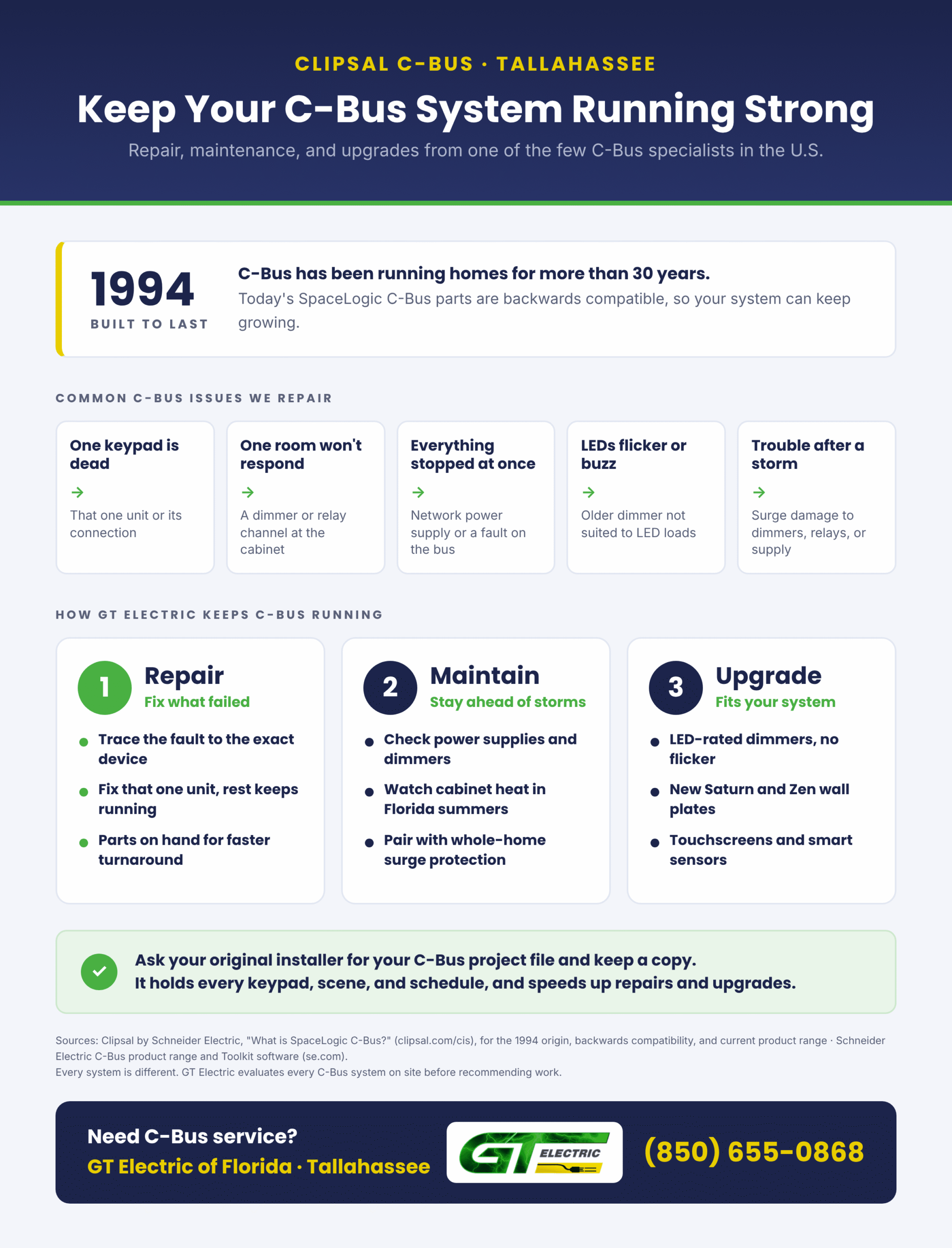
When something does go wrong, C-Bus’s design works in your favor: the problem is almost always isolated to one device, and the symptom points us right to it.
One keypad stops responding. If one wall plate is dead but every other switch works, the issue is usually local to that unit or its connection — typically a straightforward repair.
One room or group of lights won’t respond. When a keypad lights up, but the lights don’t, we look at the dimmer or relay channel feeding that circuit back at the cabinet.
Everything stops at once. When none of the keypads respond, the cause is usually on the network itself: the C-Bus power supply, the network wiring, or one unit affecting the bus. It looks dramatic, but it’s typically one component, and once it’s found, the whole house comes back.
LED bulbs flicker or buzz. Many systems were installed when incandescent and halogen bulbs were standard. LEDs on an older dimmer channel can flicker or hum, and it’s a very fixable dimmer-side issue.
Trouble right after a storm. A nearby lightning strike or a surge when power comes back can damage dimmers, relays, or power supplies. We diagnose which unit took the hit and get it back in service.
Upgrades That Work With the System You Already Have
Because current SpaceLogic C-Bus products are backward compatible, your system can keep improving right along with your home. Upgrade options include:
- LED-rated dimmers. Schneider’s newer digital phase dimmers are built for LED loads, so you get smooth, flicker-free dimming with modern bulbs.
- New wall plates and keypads. The current Saturn and Zen wall-plate ranges add refreshed styling and features like RGB indicator LEDs and built-in sensors, on the same network.
- New relay modules. Current 4-, 8-, and 16-channel relays slot into existing systems for added or upgraded circuits.
- Touchscreens and sensors. Add a touchscreen for whole-home control, or occupancy and light-level sensors for hands-free lighting.
We keep C-Bus components on hand — dimmers, relays, power supplies, touchscreens, occupancy sensors, and PC interfaces — so many repairs and upgrades don’t have to wait on an overseas order.
Why C-Bus Owners Call GT Electric
C-Bus is primarily sold in Australia, New Zealand, Asia, and the U.K., and it was only briefly sold through mainstream U.S. distribution. That’s why C-Bus expertise is so rare here — and why homeowners who find us tend to stick with us.
Two decades of hands-on C-Bus experience. We’ve worked on Clipsal systems for about 20 years. Keypads, dimmers, relays, sensors, infrared receivers, network power supplies — we’ve seen them all.
One of the few C-Bus specialists in the country. Most electricians have never worked on C-Bus. It’s a core part of what we do.
Parts on the shelf. Our C-Bus inventory means faster turnaround and fewer weeks of waiting.
A diagnosis-first approach. We start with what your system is doing, trace the fault to the specific device, and fix what needs fixing — nothing more.
Service beyond Tallahassee. We serve Tallahassee, Leon County, and the surrounding Big Bend counties, and because so few contractors work on C-Bus, we consider C-Bus service calls farther away on a case-by-case basis.
The One File Every C-Bus Owner Should Keep
Every C-Bus system is programmed with Schneider’s C-Bus Toolkit software, and that programming — which keypad controls which lights, every scene, every schedule — is saved in a project file. It’s one of the most valuable things a C-Bus owner can have.
If your original installer is still around, ask for a copy and keep it somewhere safe. If you don’t have it, don’t worry: it isn’t required for us to work on your system. Having it simply makes repairs and upgrades faster, and we can help make sure your programming is documented going forward.
Why C-Bus Work Belongs With a Licensed Specialist
Even though the keypads run on low voltage, the dimmers and relays that power your lights are connected to 120-volt circuits inside a panel or enclosure. That’s licensed electrical work. Pulling a unit off the network without knowing how the system is programmed can also leave scenes broken or lights unresponsive.
What you can do is give us a head start. Before you call, note which keypads or rooms are affected, when the issue started (especially if it was during or after a storm), roughly how old the system is, and snap photos of the keypad and, if it’s easy to see, the labels on the equipment in the cabinet.
Frequently Asked Questions
Is Clipsal C-Bus still supported? Yes. Schneider Electric continues to make and sell C-Bus, now branded SpaceLogic C-Bus, and states that its current products are backward compatible with older C-Bus equipment. Schneider also offers North American support for existing systems.
How often should a C-Bus system be serviced? A periodic maintenance review — ideally before storm season, when lightning and outages are most frequent in North Florida — is a smart habit. It’s a chance to check power supplies, dimmer cabinet temperatures, surge protection, and your system’s programming backup.
If one part of my C-Bus system fails, does it affect everything? Usually not. Because C-Bus devices work independently instead of through one central controller, a single keypad, dimmer, relay, or power supply can be repaired on its own while the rest of the system keeps working.
Why did my C-Bus system act up after a storm? Nearby lightning and surges when power is restored can damage dimmers, relays, and the network power supply. If everything went dark at once, it’s often one affected component, and once it’s repaired, the system comes back.
Can I use LED bulbs with my C-Bus system? Yes. Older dimmers may flicker or buzz with LEDs, but Schneider’s newer C-Bus dimmers are built for LED loads and work with older systems.
Can I add new keypads, sensors, or a touchscreen to my existing system? In most cases, yes. Current C-Bus wall plates, sensors, relays, and touchscreens are designed to work on existing C-Bus networks.
Do you work on C-Bus systems outside Tallahassee? We serve Tallahassee, Leon County, and the surrounding Big Bend counties, and because C-Bus expertise is so uncommon, we review requests from farther away case by case. Send us your location and a description of what’s going on.
Keep Your C-Bus System Running the Way It Was Designed To
C-Bus was a serious investment when it went in, and it’s a well-engineered system that rewards a little care. With regular maintenance, prompt repairs, and the right upgrades, it can keep running your home the way it always has — for a long time to come.
If your C-Bus system needs attention, or you’d just like it looked over before storm season, our team is ready to help.
📞 GT Electric of Florida — Tell us what your C-Bus system is (or isn’t) doing. Request C-Bus service or call (850) 655-0868
Serving Tallahassee, Leon County, Wakulla, Gadsden, and Jefferson Counties since 1979. Licensed, insured, and locally owned.