

A standby generator has exactly one job, and it only has to do that job on the worst day of the year — the day a line goes down in a storm, and the rest of the neighborhood goes dark. Every other day, it sits quietly in the side yard, doing nothing anyone notices.
That’s precisely what makes maintenance easy to skip. A generator that’s never asked to work doesn’t announce that it’s failing. The battery can be dying, the oil can be overdue, the fuel can be stale — and none of it shows up until the moment you actually need the thing to start. By then, it’s not a maintenance conversation anymore. It’s an emergency call during a hurricane, for a unit that had months of warning it never gave anyone the chance to hear.
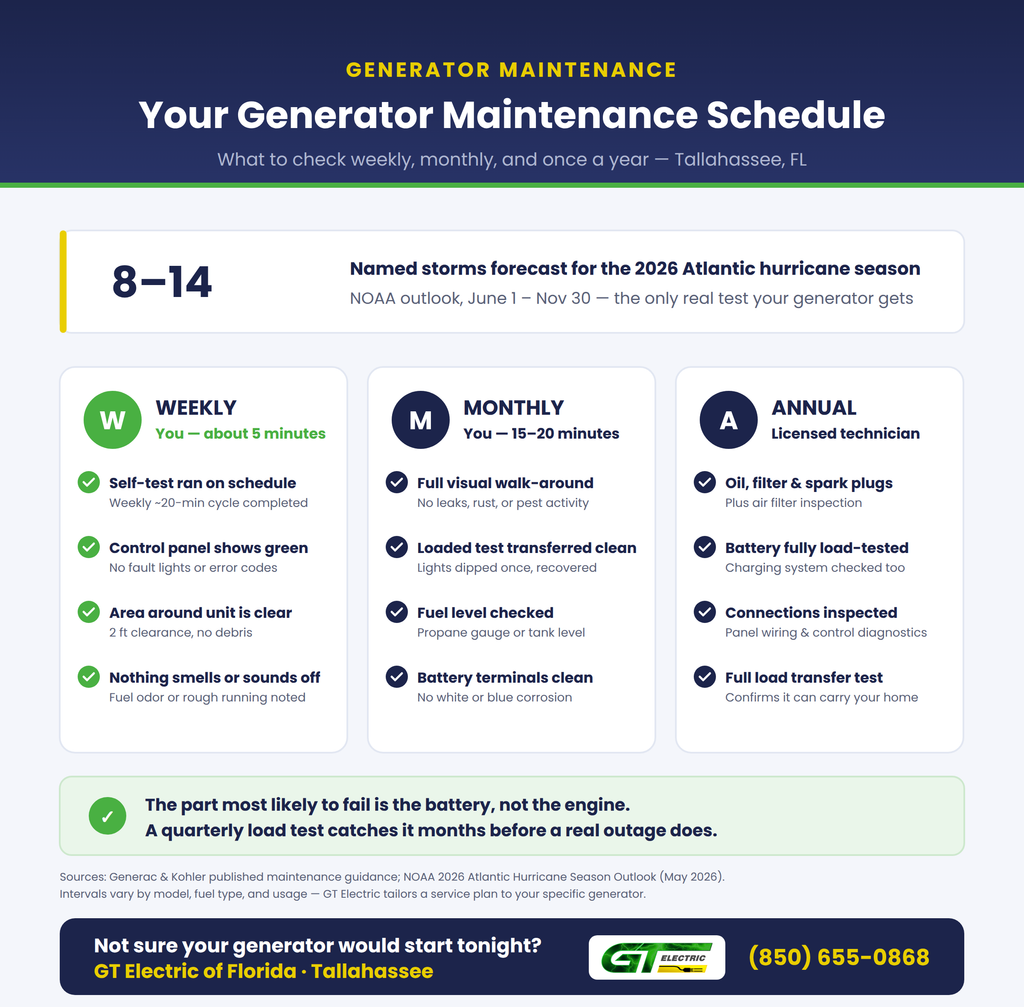
The good news: keeping a standby generator ready isn’t complicated, and most of it isn’t even yours to do. It splits cleanly into three tiers — a five-minute weekly glance, a slightly more deliberate monthly check, and professional service on a quarterly-to-annual cycle. Here’s exactly what belongs in each one, and why the schedule matters more in Tallahassee than in most of the country.
Your Generator Is Already Testing Itself — Here’s What That Test Actually Does
If you have a Generac, Kohler, or most other automatic standby generator, it doesn’t wait for you to remember it exists. It runs a self-test cycle automatically, once a week, at a time set during installation — commonly a weekday morning. That cycle typically runs about 20 minutes: the engine starts, runs through its paces, and shuts back down.
The detail worth knowing: on most systems, that weekly self-test runs unloaded by default — the engine proves it can start and run, but it isn’t asked to actually power anything. That’s a real check, but it’s not the same as proving the generator can carry your house through an outage. Many transfer switches can be set to run the weekly exercise loaded instead — briefly switching your home onto generator power and back — which is a meaningfully better test of whether the whole system, not just the engine, is ready. If you’re not sure which mode yours is set to, that’s a two-minute fix on a maintenance visit and worth asking about.
Either way, the self-test is doing real work for you. It just isn’t the whole job.
The Weekly Check (Yours — About 5 Minutes)
This one takes less time than it takes to read this section, and it’s simply about noticing rather than testing:
Listen for the self-test. If you know roughly when your unit exercises, make a mental note of whether it ran. A generator that quietly stops running its weekly cycle is telling you something before it ever tries and fails to start for real.
Glance at the control panel. Every automatic standby generator has a status light or small display. Green or “ready” means normal. Any fault light, error code, or amber/red indicator means it’s time to call — not necessarily an emergency, but not something to wait out either.
Check the area around the unit. Standby generators need clear airflow on all sides. Grass clippings, leaves, pine straw, a stored garbage can, or a tarp thrown over it after a storm can all restrict the intake or exhaust. Keep roughly a two-foot clearance, and more if landscaping has grown in since installation.
Note anything that smells or sounds different. Fuel odor, oil odor, or a self-test that sounds rougher than usual are all worth writing down, even if nothing seems urgent yet.
The Monthly Check (Yours — About 15–20 Minutes)
Once a month, take five more minutes and look a little closer:
Walk the full enclosure. Check all sides for oil residue, fuel odor, rust starting on the cabinet, corrosion at any visible connections, or pest activity (wasps and small rodents both like generator enclosures). Confirm the enclosure louvers aren’t blocked and nothing has nested inside the housing.
Confirm the exercise cycle actually ran under load, if that’s how yours is set. If your transfer switch is configured for a loaded monthly or weekly test, watch (or ask a family member to watch) that the transfer happens cleanly — lights should dip briefly and recover, not flicker repeatedly or stay dim.
Check the fuel supply. For propane or natural gas units, glance at the tank gauge if you’re on propane, and confirm there’s no fuel smell anywhere near the connection. For the rare diesel standby unit, check the tank level and look for water intrusion at the fill cap.
Look at the battery compartment, if accessible. Corrosion around the terminals — a white or bluish crust — is one of the earliest visible signs of a battery on its way out, and it’s something you can catch with a flashlight without touching anything.
None of the monthly items require opening the generator’s electrical compartment or touching wiring. If a check calls for a tool more advanced than a flashlight, it’s a professional task — covered next.
What a Licensed Technician Should Check Quarterly
Between the monthly homeowner check and the full annual service, there’s one thing worth doing on roughly a quarterly cycle: a real battery and charging-system load test. A battery can read as “fine” on a simple voltage check right up until the moment it’s actually asked to crank a cold engine — which is exactly the moment that matters. A proper load test (and specific-gravity check, on batteries where that applies) catches a weakening battery months before it becomes a no-start.
This is also typically when a technician verifies the battery charger itself is working — a healthy battery on a dead charger will still eventually fail, quietly, between visits.
Annual Service
Once a year — or every 100 to 200 hours of runtime, whichever comes first, for units that see heavy use — a full professional service should cover:
Engine service. Oil and filter change, air filter inspection or replacement, and a spark plug inspection. These are the same basic wear items as any small engine, just sized for a unit that’s expected to start reliably on the first try, every time.
Fuel system inspection. Checking for contamination, degraded lines, and correct pressure at the regulator — especially relevant for propane systems that sit unused for long stretches between real outages.
Cooling and belts. Coolant level and condition, belt tension and wear, and confirming nothing is restricting airflow through the radiator or enclosure vents.
Battery and charging system. A full test, not just the quarterly load check — plus a look at cable condition and terminal corrosion.
Electrical connections and control panel diagnostics. Loose or corroded connections in the generator’s own electrical compartment are a common, preventable cause of intermittent failures, and they’re not something to check without the panel legitimately de-energized and the right training.
A full load transfer test. This is the one that matters most and is the easiest to skip: actually transferring your home’s real electrical load onto the generator and confirming it carries it cleanly, the way it would during a real outage — not just an unloaded exercise cycle. This is also when a technician confirms your automatic transfer switch itself is switching correctly in both directions.
Keep a record of what’s done at each visit. Beyond being useful for your own tracking, service records are frequently required to keep a manufacturer’s warranty intact — a detail that’s easy to lose track of on a unit that otherwise runs itself.
Why This Schedule Matters More in a Tallahassee Backyard
Every generator dealer publishes some version of this schedule, because the underlying engineering doesn’t change by zip code. What changes here is how much slack the schedule gives you before a skipped check turns into a failure at the worst possible time.
Hurricane season is the test, and it’s long. NOAA’s 2026 Atlantic outlook, issued in May, called for 8 to 14 named storms, 3 to 6 hurricanes, and 1 to 3 major hurricanes across a season that runs June 1 through November 30 — six full months where a generator that’s been coasting on “it started last time” gets asked to prove it, often with almost no notice. Even in a season NOAA rates as more likely below-average than not, that’s still a real chance of a storm serious enough to put the whole neighborhood on generator power for days.
Heat and humidity are hard on the one part most likely to fail. North Florida’s combination of summer heat and near-constant humidity accelerates battery degradation faster than it would in a drier or cooler climate. A standby generator battery that might reasonably last close to five years in milder conditions can need replacing meaningfully sooner here — and a battery that read fine in March can be too weak to crank in August. That’s exactly why the quarterly load test matters more here than the manufacturer’s baseline schedule might suggest.
The generator is often needed by the whole street at once. When a named storm knocks out power across Tallahassee and Leon County, utility crews are triaging a large simultaneous outage, not a single house. A generator that fails to start isn’t a same-day fix in that environment — it’s a wait, in a Florida summer, with no AC and a fridge full of food, for however long repair crews take to reach a fully restored grid.
The Battery Is the Part That Actually Fails
If one component deserves more attention than the rest of this schedule combined, it’s the battery. Most standby generator failures-to-start trace back to it, not to the engine itself.
Watch for: slow cranking on the weekly self-test, a clicking sound with no start, a control panel that seems dimmer than usual, visible corrosion at the terminals, or any swelling or leaking of the battery case. Any one of those is worth a call before the next real outage, not after.
The uncomfortable part of battery failure is that it isn’t gradual in a way you can watch coming. A battery that cranked the engine fine on Monday’s self-test can be too weak to start it on Friday. That’s the entire argument for the quarterly professional load test instead of waiting for the annual visit to catch it — and it’s why “the light was green last week” isn’t the same as “it’s fine.”
What Happens When the Schedule Gets Skipped
Most generators that fail during an actual outage weren’t neglected in any dramatic way — they were just gradually deferred. A skipped oil change here, an exercise cycle that quietly stopped running there, a battery nobody load-tested in two years. Individually, none of it looks urgent. Together, it’s the standard profile of why generators fail when they’re actually needed — stale fuel, a dead or weak battery, and skipped load testing account for the large majority of no-starts we see after a storm, almost never a dramatic mechanical failure.
If you’re not confident your unit has had a real annual service — not just its own weekly self-test — that’s worth a call before the next named storm, not after one is already in the forecast. GT Electric’s electrical maintenance plans build this entire schedule into scheduled visits, so the quarterly battery check and annual load test happen on their own calendar instead of depending on anyone remembering.
Quick-Reference: The Schedule at a Glance
Weekly (you, 5 minutes): Confirm the self-test ran. Check the control panel for fault indicators. Clear debris from around the unit. Note anything unusual.
Monthly (you, 15–20 minutes): Full visual walk-around for leaks, corrosion, and pests. Confirm loaded exercise cycles are transferring cleanly. Check fuel level. Check for battery terminal corrosion.
Quarterly (licensed technician): Battery and charging-system load test.
Annually (licensed technician): Oil and filter, air filter, spark plugs, fuel system inspection, coolant and belts, full battery service, electrical connections and control diagnostics, and a full load transfer test.
Frequently Asked Questions
How often should I actually run my generator? If it’s an automatic standby unit, it’s already running its own weekly self-test — you don’t need to manually start it on top of that. What’s worth confirming is whether that test is set to run under load, since an unloaded test only proves the engine starts, not that the whole system can carry your house.
Do I really need a professional load test if the weekly self-test always runs fine? Yes. An unloaded self-test confirms the engine starts. It doesn’t confirm the transfer switch, wiring, and generator together can actually carry your home’s real electrical load — which is the one thing that matters during a genuine outage.
How long should a standby generator battery last in Florida? Often less than the three-to-five-year range quoted for milder climates. Heat and humidity accelerate the chemical degradation that eventually weakens any lead-acid battery, which is exactly why a quarterly load test catches problems the annual visit alone might miss.
What happens if I skip a year of professional maintenance? Nothing happens immediately — which is exactly the problem. Skipped maintenance doesn’t cause a visible symptom until the generator is actually called on to run through a real outage, at which point a small, cheap fix that was skipped can show up as a full no-start.
Does skipping maintenance affect my warranty? Often, yes. Most manufacturer warranties expect documented annual service, and a generator that’s never been professionally serviced can have a harder time getting a warranty claim honored if a covered part fails.
Is this the same schedule for a portable generator? No — this entire schedule assumes an automatic standby unit with its own transfer switch and self-test cycle. If you’re still deciding between the two, portable vs. whole-home generators covers how differently they’re maintained and operated.
Keep It Ready Before the Season Asks
A standby generator earns its keep in the handful of days a year it’s actually needed, and every one of those days arrives without much warning. The weekly and monthly checks are yours, take almost no time, and catch the obvious stuff early. The quarterly and annual visits are where a licensed technician catches the failure modes — a weak battery, a transfer switch that isn’t quite right, a fuel system that’s slowly degrading — that don’t show up until the worst possible moment.
If you’re not sure when your unit was last professionally serviced, or whether its weekly exercise is running loaded or unloaded, that’s worth a quick call before hurricane season finds out for you.
📞 GT Electric of Florida — Not sure when your generator was last serviced? Schedule a maintenance check: (850) 655-0868 | Contact us online
Serving Tallahassee, Leon County, Wakulla, Gadsden, and Jefferson Counties since 1979. Licensed, insured, and locally owned.