It’s 9 p.m. on a muggy Tallahassee weeknight, and you’ve got a partial power outage. The kitchen lights are on, the TV is on, but the bedrooms are dark, the AC is humming without blowing cold air, and the dryer is tumbling a load of wet towels with no heat. You open the panel expecting a tripped breaker. Every single one is sitting in the ON position.
So you’re stuck on the one question that actually matters: is this the city’s problem, or is it yours?
Most people assume a partial power outage is the utility’s problem and wait for it to come back. At GT Electric, we’ve answered enough of these late-night calls to tell you the truth: when half a house goes dark, and no breaker has tripped, the problem is very often on the homeowner’s side of the meter — and it’s one of the few electrical problems that shouldn’t wait until Monday. Sometimes it’s the utility. Sometimes it’s a harmless tripped outlet. The trick is knowing which in about two minutes.
Here’s how to tell the difference, what’s actually happening inside your service, and who to call for each answer. If you’re dealing with a full outage across the neighborhood right now, start with our Tallahassee power outage page.
The Two-Minute Test: Utility, Your Service, or One Circuit?
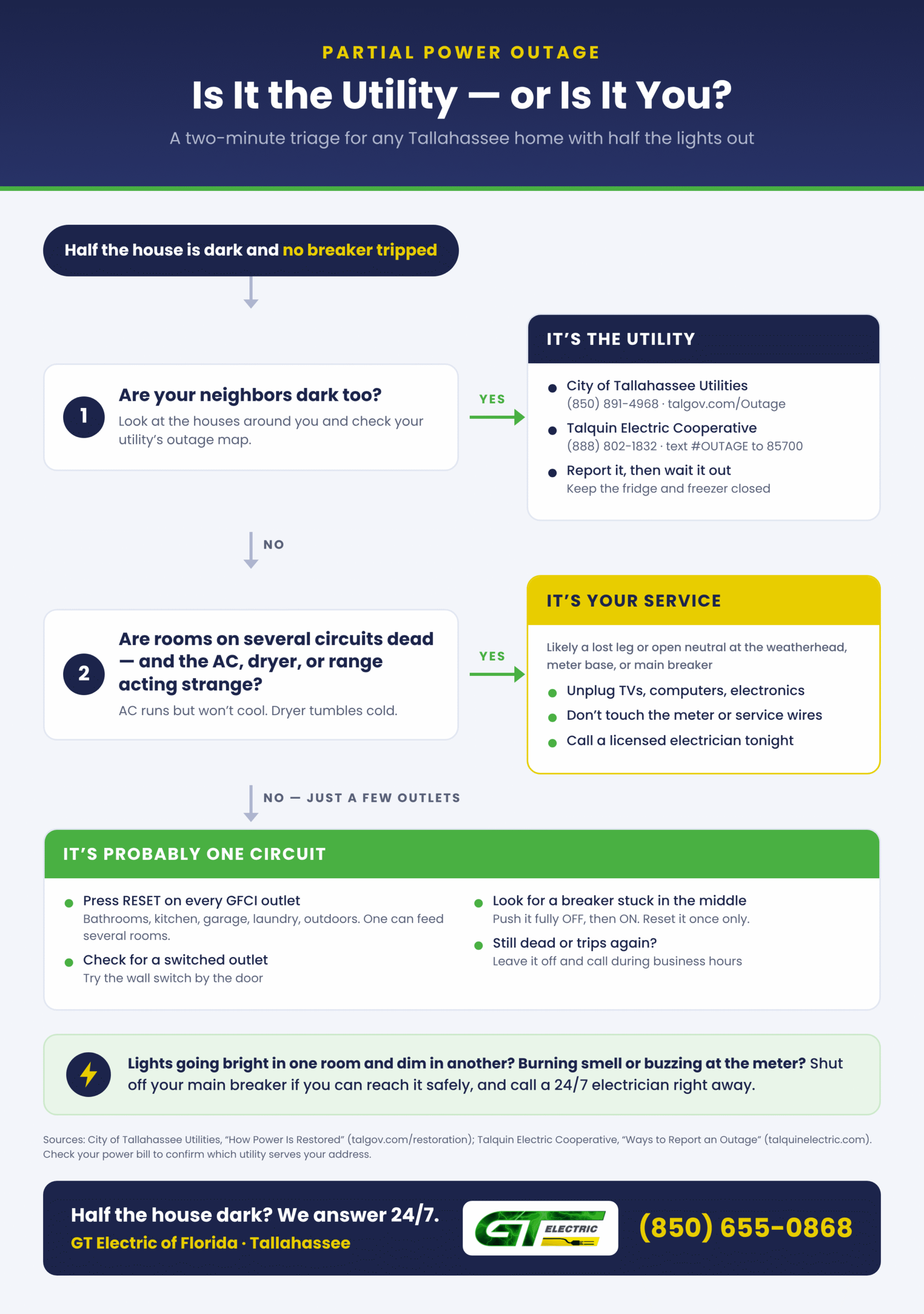
Before you call anyone, three quick checks will sort almost every partial outage into one of three buckets.
Check one: are your neighbors dark too? Look out the window at the houses on both sides and across the street. Then check your utility’s outage status. Most of the city is served by City of Tallahassee Utilities (report at talgov.com/Outage or (850) 891-4968). A meaningful share of Leon County and the surrounding area, especially toward the edges of town and into Wakulla and Gadsden, is served by Talquin Electric Cooperative instead (outage map at my.talquinelectric.com, or (888) 802-1832). If the street is dark or the map shows your area, it’s the utility. Report it and wait it out.
Check two: is it a whole half of the house? If the neighbors are lit but rooms on several different circuits are dead at once, and your big appliances are acting strange (an AC that runs but doesn’t cool, a dryer that tumbles but won’t heat, an electric range with dead burners), that points to your electrical service itself. That’s the pattern this post is mostly about.
Check three: is it just a few outlets in one area? If one bathroom, the garage, or a stretch of outdoor outlets is dead and everything else is fine, you’re most likely looking at a single circuit. That’s usually the easy one.
Why Half Your House Can Lose Power Without a Single Breaker Tripping
This is the part almost nobody explains well, and once you see it, the “half the house” symptom makes complete sense.
Your home is fed by two “hot” wires, not one. Standard residential service in North Florida comes in as three wires: two hot conductors (electricians call them legs), each carrying 120 volts, and a neutral. Every breaker in your panel is connected to one leg or the other, alternating down the panel. Your lights and regular outlets each use one leg. Your big appliances (central AC, electric dryer, range, water heater, well pump) use both legs at once to get 240 volts.
Lose one leg, and you lose roughly half your house. If a connection fails on one of those two hot wires anywhere between the utility transformer and your main breaker, every circuit on that leg goes dead at the same moment. No breaker trips, because breakers trip on too much current. They don’t trip on no current at all. Meanwhile, your 240-volt appliances are trying to run on half their supply, which is exactly why the AC hums without cooling and the dryer tumbles cold.
Where that connection usually fails. The weak spots are the mechanical connections along the path: the splice where the utility’s service wire meets your wires at the weatherhead on the roof, the jaws inside the meter base, the lugs where the service conductors land at your main breaker, or the main breaker itself. Years of North Florida heat, humidity, and storm-season wind loading on the service mast take their toll on all of them. A connection that’s been slowly corroding or loosening for years can finally let go on a perfectly calm night.
The more dangerous cousin: an open neutral. If the failure is on the neutral instead of a hot leg, you may not lose power at all. You get something worse. Without a solid neutral, the voltage on your two legs stops being balanced, and it shifts depending on what’s running. One side of the house can be pushed well over 120 volts while the other side starves. The tell is lights that go noticeably bright in one room while they dim in another, especially when a big appliance kicks on. That’s a voltage swing that can destroy electronics, appliances, and HVAC control boards in minutes, and it can overheat the failing connection itself. (If you’ve read our post on flickering lights and tripping breakers, this is the same loose-neutral warning sign. A partial outage is often where that story ends up.)
Utility Side or Your Side? Here’s Where Tallahassee Draws the Line
Once you know it’s your service and not the street, the next question is who owns the broken part. In Tallahassee, the answer is specific.
According to City of Tallahassee Utilities, the City owns the service wire running from the pole to your house and the electric meter itself. The homeowner owns the equipment attached to the house: the weatherhead, the service mast, and the meter box (the meter base the meter plugs into). Everything from there inward, including your main breaker and panel, is yours too.
That line matters, because the City is not authorized to repair privately owned equipment. If the failure is on your side, the utility can’t fix it for you. A licensed electrician has to make the repair and pull a permit, the work has to pass inspection, and then the City restores service. That’s why it pays to call an electrician early rather than waiting on a utility truck that can’t do the repair.
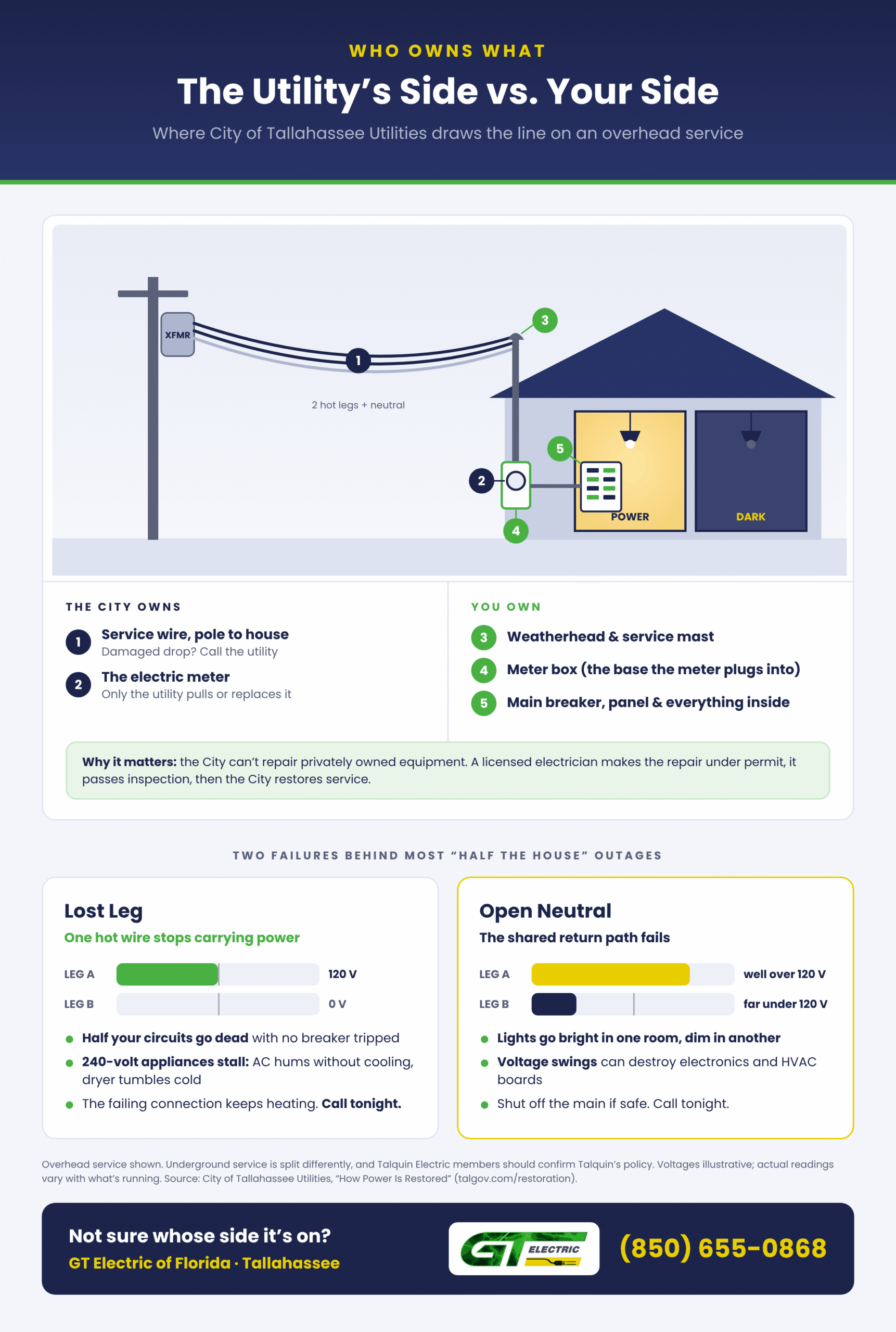
A few honest caveats. Underground service is different. If your power comes in underground rather than from a pole, the ownership line is drawn differently, so check with your utility. Talquin members should confirm Talquin’s own policy. And sometimes the failure really is on the utility’s side: a damaged service drop after a storm, a bad connection at the transformer, or a tree limb resting on the line. When we arrive and find that, we tell you so and you call the utility. Either way, you’ve lost no time.
The Harmless Explanations (and How to Rule Them In)
Not every partial power outage is a service problem. If it’s just a few outlets in one area, check these first. All of them are safe for a homeowner to look at.
- A tripped GFCI somewhere upstream. Ground-fault (GFCI) outlets, the ones with TEST and RESET buttons, often protect other outlets downstream. One tripped GFCI in a bathroom can kill outlets in a second bathroom, and one in the garage can take out the outdoor outlets and the freezer. Check every GFCI in the bathrooms, kitchen, garage, laundry, and outside, and press RESET firmly.
- A breaker that looks on but isn’t. A tripped breaker often stops in the middle position instead of flipping all the way to OFF, and it’s easy to miss. Push any breaker that looks slightly out of line fully to OFF, then back ON. Reset it once. If it trips again, leave it off and call.
- A switched outlet. Some outlets, often in bedrooms and living rooms, are controlled by a wall switch so you can plug in a lamp. If a lamp “has no power,” try the light switches by the door.
- One failed outlet in a daisy chain. Outlets on a circuit are often wired one to the next. When one outlet’s internal connection fails, every outlet past it on that run goes dead too. That’s not a tonight emergency, but it is a loose or burned connection behind a wall, so it’s worth a call during business hours rather than a shrug.
If none of those bring the power back, and especially if more than one room is affected, go back to the two-leg explanation above.
What to Do Tonight if Your Partial Power Outage Is on Your Side
If the neighbors are lit and half your house is dark, or your lights are going bright and dim, here’s what’s safe for you to do while you wait for help:
- Turn off and unplug sensitive electronics: computers, TVs, and anything with a control board. Voltage swings from an open neutral are what destroy them.
- If lights are going bright and dim, or you smell something hot or hear buzzing at the meter or panel, shut off your main breaker if you can reach it safely and the panel area is dry. That stops the voltage swing on your side.
- Don’t touch the meter, the meter base, or the wires at the weatherhead. Even with your main breaker off, those parts are still live from the utility side, and pulling a meter is the utility’s job, not a homeowner’s.
- Don’t run a portable generator through a dryer outlet or any other “backfeed” setup to get the dark half going again. It’s dangerous for you and for line crews working on the system.
- Call a licensed electrician who answers at night. GT Electric’s 24/7 emergency electrical service exists for exactly this.
When we arrive, we test voltage at the panel on each leg and between each leg and neutral, trace the drop back toward the meter and weatherhead, and tell you plainly whether the fault is ours to fix or the utility’s to fix. If it’s the main breaker, a corroded meter base, or a panel that’s simply worn out after decades of storm seasons, we’ll walk you through the repair, or a panel upgrade if that’s honestly the better answer.
Why Partial Power Outages Show Up After Storms in the Big Bend
Partial power outages cluster after severe weather, and there’s a mechanical reason. A tropical storm or a summer squall line doesn’t have to knock your power out to cause one. Wind loads the service drop and tugs on the mast and weatherhead. Water finds its way into a meter base. A limb brushes the line and stresses the splice. The house keeps power through the storm, and then a connection that was damaged that afternoon fails three days later.
That’s why a partial outage, or lights that suddenly start acting strange, in the weeks after a storm deserves a real look. Our post-storm electrical safety check walks through what else to watch for once the weather clears.
Frequently Asked Questions
Why does my power keep going out in only part of my house? If the same rooms keep going dark and coming back with no breaker tripping, the most common cause is a loose or corroded connection on one leg of your service: at the weatherhead, the meter base, or the main breaker lugs. Intermittent is not better than constant. A connection that keeps making and breaking contact is heating up and arcing each time.
Can a partial power outage fix itself? If the cause is on the utility’s side, yes. Your power comes back when they repair it. If the cause is a failing connection on your side, the power may come back on its own for a while, but the connection is still bad. It will fail again, and in the meantime it’s generating heat. Power returning is not the same as the problem being fixed.
My breaker isn’t tripped, but there’s no power to one outlet. What’s going on? Start with the harmless list: an upstream GFCI that tripped, a breaker resting in the middle position, or an outlet controlled by a wall switch. If those check out, a failed outlet or loose connection earlier in that circuit is the likely cause. That’s worth a call, but usually not a midnight one.
There’s no power to my thermostat, but the breaker didn’t trip. Is that the same problem? It can be. Your thermostat is powered from your HVAC system, so if half the house is out and the AC is misbehaving, that points back to a lost leg on your service. If everything else in the house is normal, the cause is more likely inside the HVAC equipment itself, such as a blown control fuse or a tripped condensate safety switch. That’s a call for your HVAC contractor.
How do I fix a partial power outage in my house? You can safely check the GFCI outlets, reset a tripped breaker once, and confirm whether your neighbors have power. Anything beyond that, including anything at the meter, weatherhead, main breaker, or inside the panel, is licensed work, and in Tallahassee repairs to service equipment require a permit and inspection before the City will restore power.
Is it the City of Tallahassee or Talquin Electric I should call? It depends on your address. Most of the city is served by City of Tallahassee Utilities, and Talquin Electric Cooperative serves a large share of the surrounding counties, with boundaries that don’t always follow city limits. Your power bill will tell you. If you’re not sure the problem is on the utility’s side, call us. We’ll tell you whose side it’s on.
Will a whole-home generator keep my lights on during a partial outage? A properly installed whole-home generator protects you from utility outages, which is what it’s built for. It won’t fix a failed connection at your meter or main breaker, and whether the generator even starts depends on where the fault is and how your transfer switch senses utility power. That’s another reason to get the service itself diagnosed.
Know Whose Problem It Is Before You Wait It Out
A partial power outage is your house telling you something specific. The trick is reading it before you spend a night waiting on a utility truck that can’t fix your meter base, or before an open neutral takes out your AC board and your TV.
Two minutes of checking tells you which bucket you’re in. If it’s the utility, report it and relax. If it’s one circuit, it’s probably simple. If it’s half the house, call someone tonight.
📞 GT Electric of Florida — Half the house dark and no breaker tripped? We answer 24/7. Call: (850) 655-0868 | Contact us online
Serving Tallahassee, Leon County, Wakulla, Gadsden, and Jefferson Counties since 1979. Licensed, insured, and locally owned.