The clocks fell back on Sunday, November 1. You got an extra hour of sleep, your car clock is wrong until spring, and somewhere in your hallway there’s a smoke detector that hasn’t been tested since the last time somebody burned the toast.
That’s why fire departments tie detector checks to the time change. It’s an easy date to remember.
Here’s the problem: the old advice was written for battery smoke alarms. Most Tallahassee homes built in the last few decades have hardwired smoke detectors — alarms wired into your home’s 120-volt electrical system, usually with a backup battery and often linked together so one sets off all the others. People assume hardwired means maintenance-free. It doesn’t. At GT Electric, we see the same pattern on inspection after inspection: alarms that are past their replacement date, backup batteries that are dead or missing, and interconnected systems where one unit has quietly stopped talking to the rest.
Hardwired alarms do work better — NFPA data shows they operated in 94% of home fires big enough to set them off. But only if they’re in date and the backup battery is good. Here’s what to check this week, what each beep actually means, and how Florida law treats carbon monoxide (CO) alarms.
Why “Hardwired” Doesn’t Mean “Set It and Forget It”
Hardwired alarms still have batteries. Nearly every hardwired smoke and CO alarm has a backup battery so it keeps working when the power’s out. In the Big Bend, that’s not a footnote. Storm outages are exactly when people light candles, run space heaters, and fire up generators — and a hardwired alarm with a dead backup battery goes completely silent the moment the power drops.
The sensors wear out. The National Fire Protection Association (NFPA) and the U.S. Fire Administration both say to replace smoke alarms 10 years from the date of manufacture printed on the unit, not from the date you moved in. CO sensors wear out faster: many older CO alarms are rated for 5 to 7 years, and newer sealed models often last 10. Your alarm’s label has the real answer.
Interconnected systems fail quietly. In a home with interconnected smoke detectors, one alarm sounding should trigger every alarm in the house. If a wire connection loosens, or someone replaced one unit with an incompatible brand, that alarm may still beep on its own but won’t set off the others. You’d never know until you test.
And the stakes are real. According to NFPA, about three of every five home fire deaths happen in homes with no smoke alarms or no working ones.
The 10-Minute Fall Check for Hardwired Smoke Detectors
Do this once, right after the time change, then keep up the monthly test. Everything here is safe for a homeowner.
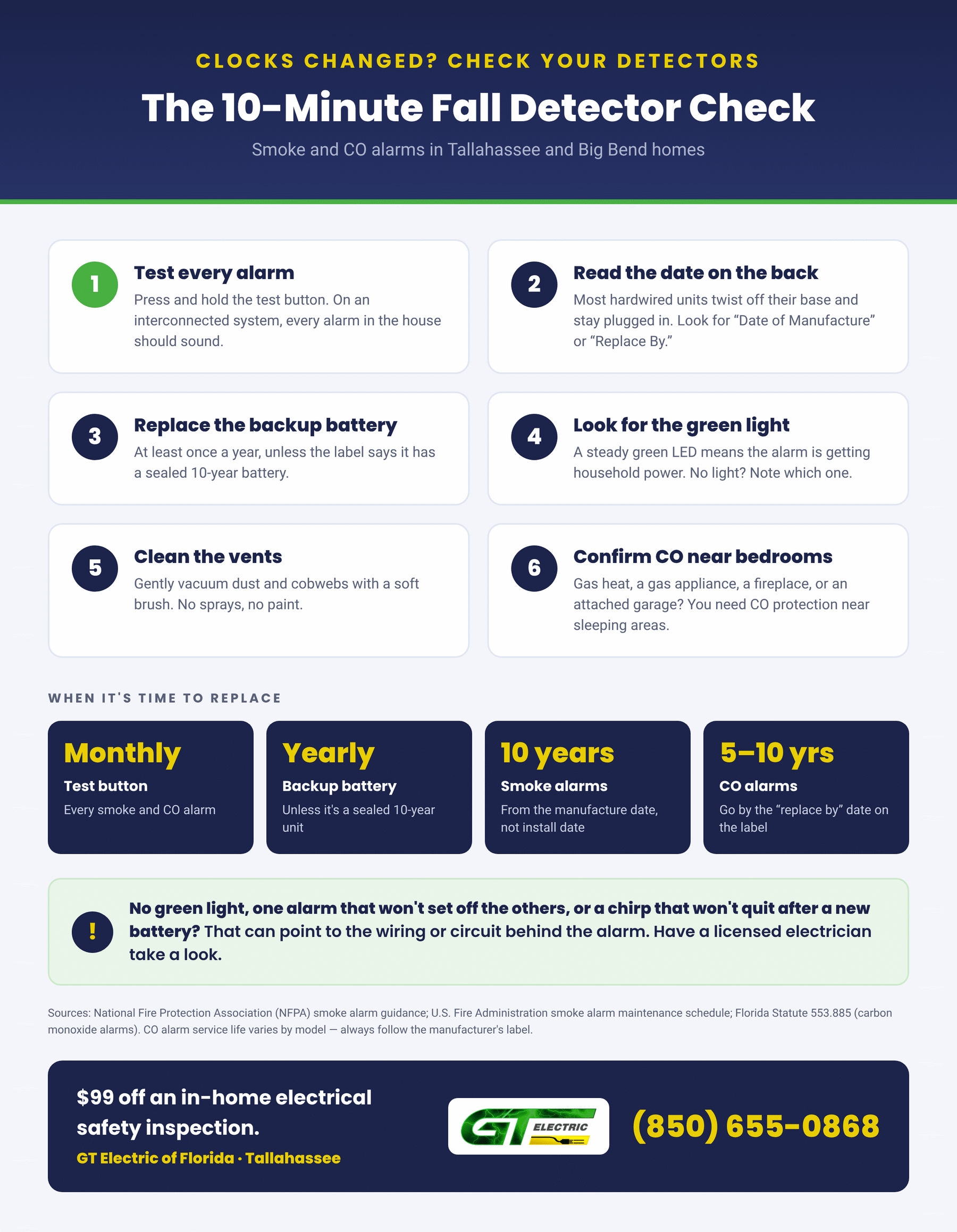
- Press and hold the test button on every alarm. Use a sturdy step stool, not a chair. If your alarms are interconnected, every alarm in the house should sound when you test one. If one stays quiet, make a note of which one.
- Check the date on the back. Most hardwired alarms twist counter-clockwise off their mounting plate and stay plugged into a short wiring harness, so you can read the label without touching any wires. Look for “Date of Manufacture” or “Replace By.” Smoke alarm 10 years or older? It’s due. CO alarm past its replace-by date? Also due. If yours doesn’t twist off easily, leave it and have a professional check it.
- Replace the backup battery. The U.S. Fire Administration recommends replacing hardwired backup batteries at least once a year, unless your alarm has a sealed 10-year battery (it will say so on the label). The time change is a good time to do it.
- Look for the green light. Most hardwired alarms have a small steady green LED that shows they’re getting household power. No light on a hardwired unit can mean it’s not getting power at all.
- Clean them. Florida humidity, dust, and the occasional spider make alarms less sensitive and cause false alarms. Gently vacuum the vents with a soft brush attachment. Don’t spray cleaners or paint on them.
- Count your CO alarms. If your home has gas heat, a gas water heater, a gas range, a fireplace, or an attached garage, you need CO protection near the bedrooms. More on that below.
Chirp, Beep, or Full Alarm? Why Your Smoke Detector Is Chirping
Not every noise means the same thing, and the most annoying one has a habit of starting at 3 a.m.
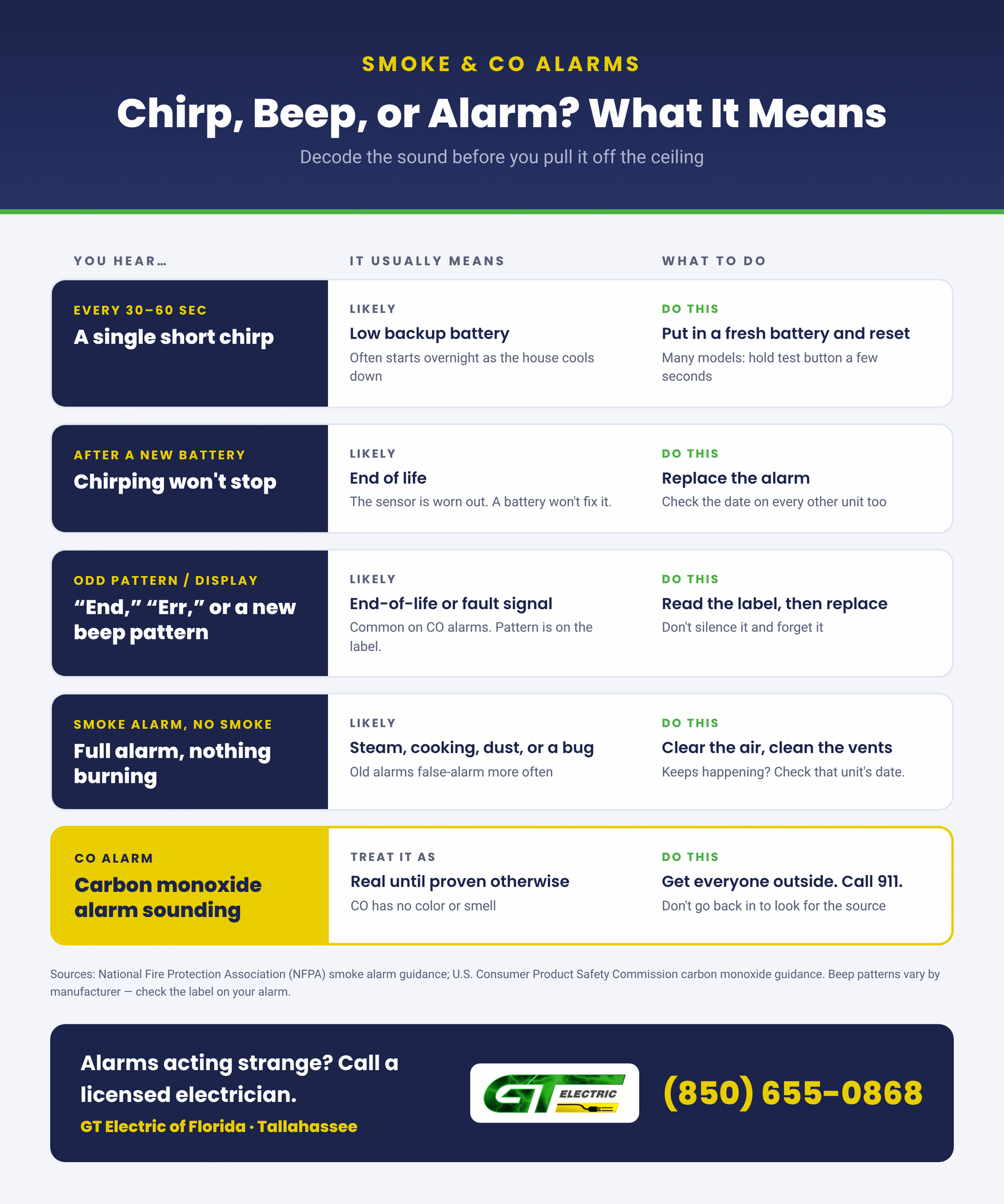
A single chirp every 30 to 60 seconds usually means the backup battery is low. NFPA notes that if the chirp keeps going after you’ve put in a fresh battery, the alarm has reached the end of its life and needs to be replaced — a new battery won’t fix it. Low batteries often start chirping overnight, as the house cools down and battery voltage dips.
A different chirp pattern, or “End” / “Err” on a display is often an end-of-life signal, especially on CO alarms. The pattern varies by brand, and it’s printed on the label. End-of-life means replace the alarm, not the battery.
The full loud alarm with no smoke in sight is usually steam from a bathroom, cooking smoke, dust, or an insect in the sensor chamber. Old alarms false-alarm more often too. If one unit keeps doing it, check its date.
A CO alarm sounding is never a false alarm until proven otherwise. Get everyone outside into fresh air, then call 911. Don’t go back in to find the source. Carbon monoxide has no color or smell, and the early symptoms (headache, dizziness, nausea) are easy to mistake for the flu.
Carbon Monoxide in North Florida Homes: It’s Not Just a Northern Problem
People tend to think CO alarms are for places with long winters. North Florida has three good reasons to take them seriously.
The first cold snap. Early November is when Tallahassee homes fire up gas furnaces, gas space heaters, and fireplaces for the first time in months. A cracked heat exchanger or a blocked flue shows up on the first chilly night, not in July.
Attached garages. A car warming up in an attached garage, even with the door open, can push CO into the house.
Storm season generators. After major Florida hurricanes, there are carbon monoxide deaths tied to portable generators running inside garages or too close to windows and doors. If you rely on a portable generator during outages, a working CO alarm with a good backup battery isn’t optional. (A permanently installed whole-home generator placed and vented to code removes that risk entirely, and our standby generator maintenance schedule covers how to keep one ready.)
What Florida Law Says About Smoke and CO Alarms
Two Florida statutes are worth knowing, and both come with honest limits on what they require.
CO alarms in newer homes. Under Florida Statute 553.885, new construction permitted on or after July 1, 2008 that has a fossil-fuel-burning heater or appliance, a fireplace, or an attached garage must have a carbon monoxide alarm within 10 feet of each room used for sleeping. It can be hardwired, battery-powered, or a combination smoke/CO alarm. The rule applies to new buildings and additions; it doesn’t force older homes to retrofit. But the reasoning applies to any home with gas appliances or an attached garage.
10-year sealed batteries for battery-only alarms. Under Florida Statute 553.883, when a battery-powered smoke alarm is installed or replaced as part of a “level 1 alteration” (the Florida Building Code’s term for remodel-type work), it must use a sealed, nonreplaceable 10-year battery. That rule is about battery-only alarms. It doesn’t change anything about hardwired systems.
What modern code calls for. For new homes, the national fire alarm code (NFPA 72) calls for hardwired, interconnected smoke alarms with battery backup in every bedroom, outside each sleeping area, and on every level. If your home is older and only has one or two alarms in the hallway, it’s worth talking through what better coverage would look like.
Need an alarm and can’t afford one? The Tallahassee Fire Department runs a long-standing Smoke Alarm Program for senior citizens and low-income residents. You can request one at talgov.com/Fire or by calling (850) 891-6600.
When a Detector Check Turns Into an Electrical Question
Most of the fall check is homeowner territory. A few findings point to something electrical behind the ceiling:
- A hardwired alarm with no green power light even though the breaker is on.
- One interconnected alarm that won’t trigger the others, or a whole system that goes off at random.
- Alarms that keep chirping after a new battery, a cleaning, and a reset.
- Discoloration, a burnt smell, or a warm mounting plate.
- A detector circuit that shares a breaker with something that trips — so when that breaker goes, your alarms lose household power too.
Swapping out a hardwired alarm means working on a live 120-volt circuit and matching the interconnect wiring. If you aren’t completely comfortable with that, it’s a job for a licensed electrician.
Your detectors are only as reliable as the wiring and circuit behind them. That’s where an in-home electrical safety inspection earns its keep: a licensed electrician looks over your panel, breakers, outlets, GFCI protection, and wiring condition, and tells you plainly what needs attention and what doesn’t. (Our 10-point electrical safety checklist shows what you can look at yourself in the meantime.)
If you’d rather never have to remember any of this, GT Electric’s electrical maintenance plans build a smoke/CO detector check into the annual visit, along with a panel inspection and priority scheduling.
Frequently Asked Questions
Do hardwired smoke detectors need batteries? Most do. Hardwired alarms run on household power, but nearly all have a backup battery so they keep working during an outage. Replace a standard backup battery at least once a year. Some newer hardwired alarms have a sealed 10-year backup battery that never needs replacing. The label will tell you which you have.
How often should hardwired smoke detectors be replaced? Every 10 years from the date of manufacture printed on the alarm, according to NFPA and the U.S. Fire Administration. Being hardwired doesn’t extend that. The sensor inside wears out the same way. Replace sooner if an alarm fails its monthly test or keeps chirping after a new battery.
Why is my hardwired smoke detector chirping with a new battery? The most common reason is that the alarm has reached the end of its life, and NFPA says to replace it. Other causes include a battery that isn’t fully seated, a battery door that isn’t closed, or an alarm that needs to be reset after the battery change (many models have you hold the test button for several seconds). If you’ve tried all of those, check the date.
How long do carbon monoxide detectors last? It depends on the model. Many older CO alarms are rated for 5 to 7 years, and many newer sealed units last 10. Go by the “replace by” date or the manufacturer’s instructions on the label, and replace any CO alarm that gives an end-of-life signal.
Should I change my smoke detector batteries when the clocks change? It’s a good habit, and it’s how fire departments get people to remember. For hardwired alarms with replaceable backup batteries, once a year is the minimum, so the fall time change is a natural time to do it. Test every alarm monthly regardless.
Can I mix brands on an interconnected smoke detector system? Usually not. Interconnect signals generally only work between alarms from the same manufacturer, and sometimes only within compatible model lines. A mismatched unit may sound on its own but fail to trigger the rest. Check the manufacturer’s compatibility list before replacing any unit.
Is a combination smoke and CO alarm good enough? It can be, as long as it’s listed for both and placed correctly. Florida’s CO statute specifically allows combination smoke/CO alarms. Keep in mind the CO sensor may reach end of life before the smoke sensor does, and the unit gets replaced on whichever date comes first.
Ten Minutes Now Beats Finding Out the Hard Way
Your smoke and CO detectors are the only part of your electrical system whose whole job is to wake you up when something is going wrong. The clocks just gave you a reminder. Test every alarm, read the dates, swap the backup batteries, and make sure the interconnect works.
If anything doesn’t check out, or you’d rather have a licensed electrician look over the electrical system behind those alarms, we’re here.
📞 GT Electric of Florida — For a limited time, get $99 off a comprehensive in-home electrical safety inspection. Call: (850) 655-0868 | See current special offers
Serving Tallahassee, Leon County, Wakulla, Gadsden, and Jefferson Counties since 1979. Licensed, insured, and locally owned.